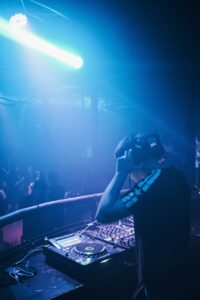
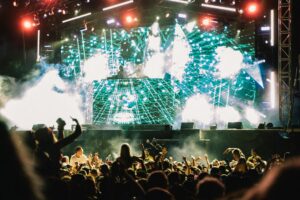
There used to be a kind of magic in watching a DJ navigate a room across three hours, moving from disco to house to hip-hop to Afrobeat and back again, holding a crowd by the ears and never letting go. That DJ had a name: the open format DJ. And in 2026, that DJ is nearly extinct. Not because the skill has vanished, but because the world around it has shifted so dramatically that versatility is now treated as a liability rather than a gift. This is not a nostalgic lament. This is a sharp-eyed look at how genre purity, social media branding, algorithmic culture, and the economics of nightlife have quietly conspired to bury one of the most demanding and exhilarating disciplines in DJ culture.
The Festival Lineup as a Genre Manifesto
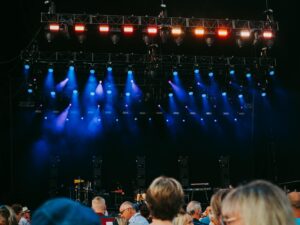
Walk through any major festival lineup in 2026 and you will see the same architecture repeated without apology. Each stage is a genre silo. Techno purists own one tent. Melodic house disciples occupy another. Afro house, drum and bass, hyperpop — each locked into its own branded corner of the site. Booking agents and festival directors no longer want someone who can do it all. They want a genre ambassador, a specialist who arrives with a pre-built audience already primed to follow them anywhere.
This is not accidental. Festival economics demand predictability. A genre-specific DJ brings a defined tribe. Their booking is a marketing decision as much as a musical one. The open format DJ, by contrast, arrives with a question mark hanging over the room. Who is their audience? What do they sound like? In a world where festival slots are sold six months in advance and every stage has a sponsorship package tied to a sonic identity, ambiguity is expensive.
The result is that festival lineups have become increasingly rigid taxonomies. The open format DJ — the artist who once served as the connective tissue between genres and between audiences — has no obvious home on that map.
Social Media Killed the Undefined Brand
If festival economics built one wall around the open format DJ, social media built three more. The logic of platforms in 2026 is brutal and simple: you must be instantly identifiable, endlessly consistent, and permanently on-message. An artist who plays techno one night, R&B the next, and deep house the weekend after does not fit that logic. The algorithm cannot categorise them efficiently. The audience cannot follow them instinctively. And the engagement numbers — those merciless arbiters of digital relevance — begin to slide.
Genre-specific DJs have thrived in this environment precisely because they are algorithmically legible. A techno DJ posts a clip from a dark warehouse set and every platform knows exactly who to show it to. A dark, filtered fifteen-second video of a crowd losing their minds to a peak-time techno drop travels effortlessly because the machine understands it. The open format DJ posts a video moving between Frank Ocean and Bicep and the algorithm shrugs, unable to decide whether this belongs to the R&B audience or the electronic music crowd.
Research published in 2025 by New Scientist found that social media algorithms can shift user preferences and perceptions within days of consistent content exposure. Apply that finding to DJ culture and the implications are stark. Audiences are increasingly conditioned by their feeds to expect a single, coherent sonic identity from the artists they follow. Anything that disrupts that expectation registers not as versatility but as inconsistency. In the social media era, the open format DJ does not read as skilled. They read as unfocused.
When the Algorithm Replaced the Art of Reading a Room
Here is where the loss becomes truly painful. The open format DJ was, above everything else, a reader of rooms. That skill — the ability to sense a shift in the crowd’s energy before it becomes visible, to know when to drop the tempo and when to push it, to gamble on an unexpected record and win — took years to develop. It was the product of thousands of nights on the floor, watching, listening, adjusting, failing, and eventually mastering.
Algorithm-driven playlists have made that skill seem unnecessary to a generation that has grown up with Spotify and Apple Music anticipating their every mood. Why trust a human to read the room when a machine has already read you? Club promoters now frequently describe their ideal event in algorithmic terms: a consistent BPM range, a predictable sonic palette, a clearly defined audience demographic. The open format DJ, whose greatest weapon was unpredictability deployed with precision, finds themselves solving a problem the market has decided no longer exists.
As a platform built by people who have spent years collecting records and studying crowd dynamics, STRAST knows this loss intimately. Music discovery, as Marco Weber described in conversation with Magnetic Magazine, used to be an obsessive and deeply personal pursuit, driven by crate digging, human recommendation, and genuine curiosity. The open format DJ was the living embodiment of that pursuit — someone who had done the work across every genre and could deploy it in real time. That figure is increasingly invisible in a landscape where discovery is outsourced to a recommendation engine.
Nightclub Culture and the Tyranny of Genre Purity
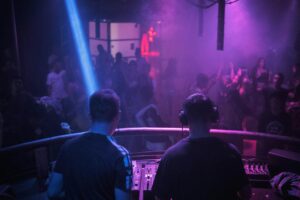
Walk into the most critically celebrated clubs of 2026 and you will encounter a new kind of orthodoxy. Genre purity is not just preferred — it is enforced. Techno nights that run eight hours without a single stylistic deviation. House nights where every record is filtered through the same sonic template. The crowd arrives dressed for it, primed for it, and in some cases openly hostile to anything that disrupts the liturgy.
This shift reflects a broader cultural anxiety about identity and belonging. In an era of fragmentation and noise, genre functions as tribe. People do not just want music. They want a community that shares their exact taste, their exact aesthetic, their exact idea of what a night out should feel like. The open format DJ threatens that comfort. They are a disruptor in a culture that has decided it is done with disruption.
The irony is profound. Club culture was built on disruption. Disco, house, techno, drum and bass — each of these movements was born from genre-crossing, from DJs who refused to stay in their lane. The open format DJ is not a dilettante. They are the direct descendant of the people who created modern club culture. And the culture they helped build has turned its back on them.
A Eulogy That Demands a Response
The open format DJ is not yet dead. But the conditions for their survival are narrowing with every festival lineup announcement, every algorithm update, and every club night that mistakes sonic repetition for artistic integrity. If DJ culture loses the open format artist entirely, it loses something it cannot retrieve from a playlist or a genre manifesto. It loses the human being in the booth who knows that sometimes the most devastating move is to play a record nobody expected.
If you believe that versatility is a virtue and that the ability to move a room across genres is one of the great skills in modern music, then say so. Support the DJs who still take that risk. Demand more from the lineups you attend and the playlists you consume. The open format DJ deserves more than a eulogy. They deserve a room full of people willing to follow them anywhere.
Explore the STRAST archive at djstrast.com and find out what it means to play without borders.